“Our last trip to Iowa, where the Sebring Sprites are located, was in mid-March, 2020.  We continue to work on them, albeit from a distance. Still a few items to locate, still a few more engineering issues to sort through and still a few more historical details to investigate. We have not yet received the FIA HTP’s for the three cars we had inspected last fall. This is understandable, as the FIA is not an “essential” business and they are most likely not having staff in to complete these. None the less, it’s a bit disconcerting as we’ve invested a significant sum into the inspection fees and shop time to complete the applications. Below are a few insights into the various ongoing projects:
Alloy-bodied Coupe
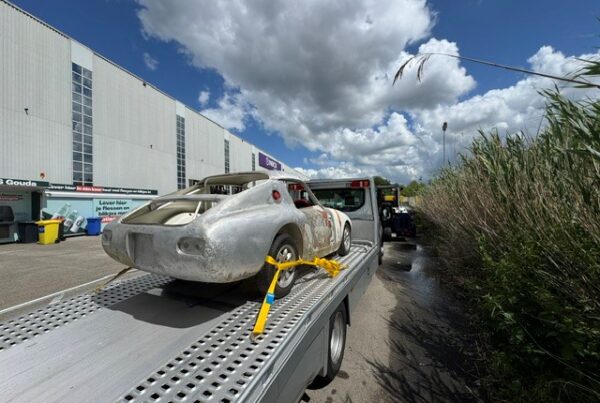
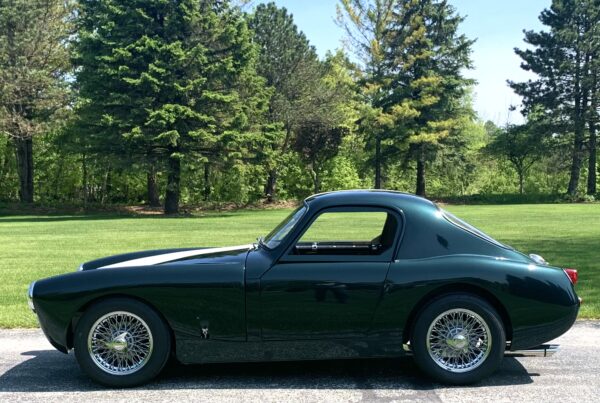
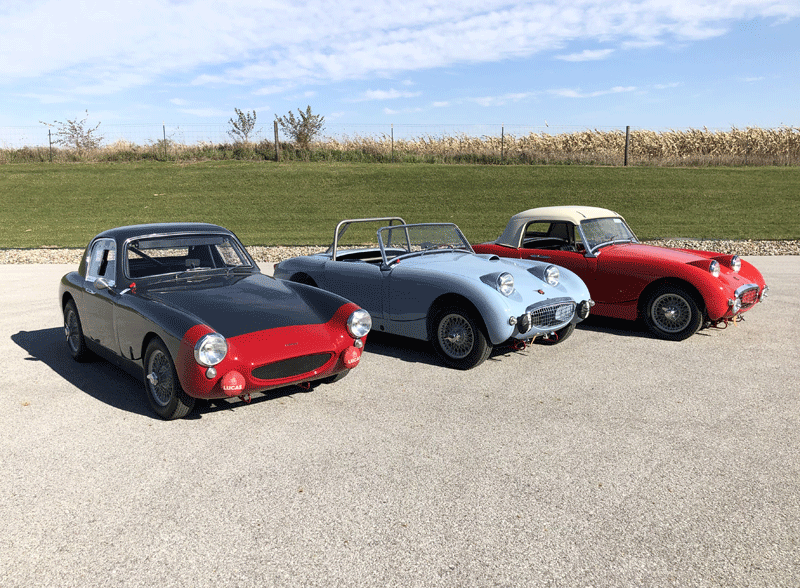
The alloy-bodied coupe is largely complete, although I find we still have several items to complete to make the car truly track-ready. We’ve deferred the purchase and installation of many of those safety items that carry an expiration date, as there was little point of seeing them go out of date limit while setting on the shop floor. We are hoping to get a little private track time later this year to work on sorting out suspension and handling of the coupe. I suspect we’re over sprung in the backend, as it seemed a bit skittish during the couple of short road trips we’ve taken it on. As you know we’ve done very little to publicize the car. We’ve made one trip to the 2018 Sprite 60th Anniversary at Elkhart Lake, and one trip to the Austin Healey Club of America 2019 Conclave in South Dakota. None the less, I’ve managed to garner a fair number of criticisms for lack of authenticity. I am, slowly, building a photo library of, what I call, rectifications. Some of these details we can clear up fairly quickly, others might be down to a future owner. In my defense; many of the deficiencies relate to either interferences with safety equipment, or interpretations of the original FIA Recognition form #47. As I wasn’t out to create a museum piece, nor willing to compromise on driver’s safety, I’ve had to make decisions that may not meet others expectations. For example, while I would very much like to incorporate the twin SU fuel pumps that John Sprinzel had installed in the rear of the cockpit, the FIA looks unkindly on vinyl fuel tubing in the cockpit. I have installed twin pumps, but they are safely tucked way in the FIA approved fuel cell. In a future email I will catalog the choices we had to make in the build.
Standard-bodied Sebring Sprite
The red standard-bodied Sebring Sprite patterned, generally, after XOH 276, is also largely complete. There are a few wiring issues to be completed but otherwise the car is ready for suspension tuning and development work. There are a number of long-term projects that I’ll need to address in the coming months/years:
* We had the pictures taken for the initial FIA HTP application with the DHMC hardtop fitted, but without the glass rear screen installed. We had to resubmit the photos to the FIA with a rear screen in the hardtop, and ended up using a BMC hardtop, as we’ve found there is an issue with fitting the rear screen in my DHMC hardtop. I’ve ordered several of the replica DHMC hardtops from Sven, but I think the long-term solution will be to locate one of the Universal Laminations / Denis Ferranti hardtops that are more appropriate for the July 1958 car. Tom Coulthard and John Sprinzel have a photo of one of these tops on the front cover of “Spritely Years”, the photo being of PMO 200 during the Coupe des Alpes in July 1958. Herve Chevalier has three more photos of PMO 200 taken during the ’58 Alpine in his work “Les Healey dans les Alpes”. Referring again to “Spritely Years”, there are two more pictures, on page 39, of the Universal Lamination top fitted to PMO 200 with the nine-stud windscreen, this time for the 1958 Liege-Rome-Liege. I do have the correct nine-stud windscreen frame for this car, but had the later windscreen frame installed to use the DHMC top.
* I’ve finally found the answer to another bit of Sprite mystery. Were you aware there were two rear axle casings (housings) for the AH Mk1, Frogeye, Sprite? Part number ATA7329 gave way to new part number ATA7618 at chassis number AN5/4333. We discovered one of the differences in the rear axle casings when offering up a narrowed axle housing and finding the rear shocks links wouldn’t meet the bracket on the axle casing. Upon measuring we discovered the distance between the shock link brackets differs between early and late rear axle housings by ~1 in. I’ve reached out to my contact, a specialist on Armstrong shocks, and he has confirmed there is a difference in the offset in shock arms of early shocks 2A7298/2A7298 and late shocks AHA5312/AHA5311 that would account for the almost 1” difference in bracket spacing. The upshot of all this is that in a future project I will want to get the arms changed on the Armstrong adjustable shocks currently on the car and install the earlier axle housing so all the 1958 bits match up.
* One further project being undertaken is to swap out the current C39 generator and RB106 control box for the uprated C40 generator and RB310 control box specified by Geoff Healey in ST 200 (1959 Sebring). You’ll remember I had started trying to source the double bearing C40 generator with tach drive some years ago, before getting discouraged and setting it aside. I’ve now got a much larger supply of generator parts so I’ll tackle it again. I hadn’t previously realized that the change from the RB106 to RB310 control boxes is not a simple parts swap. The RB106 is five-screw terminals, while the RB310 is three-screw terminals, so I’ve gotten an automotive electrical firm involved to create the appropriately modified wiring diagram.
* I still want to fabricate the twin pipe exhaust system, as Geoff Healey had used on the 1959 Sebring cars. There are still quite a few good pictures of the Butch Gilbert restoration that show the detail of the twin pipe exhaust system.
Standard-bodied Bonneville Sprite
We still have to fit the blower oil feed, plumb in the oil cooler and finish the wiring. I’m running a Setrab oil cooler mounted vertically along the R/H side of the radiator to mimic the period installation. Some of the other details are described below:
The blue standard-bodied Bonneville Sprite has been, generally, patterned after the 1960 Alpine rally car of Tommy Wisdom and Jack Hay, 7080 AC. Wisdom and Hay had run the car with the soft top, which makes further development of this car in the historical configuration really problematic. The Sebring Sprite falls into Period E of FIA Appendix K, with rollover protection recommended. The Bonneville Sprite falls under Period F of FIA Appendix K, where rollover protection becomes obligatory. I’ve put roll-over protection(ROPS) in both the alloy-bodied coupe and the standard-bodied Sebring Sprite, and in each case we’ve been able to fit it under the roof/top. It’s just not realistic to get the ROPS under a soft top in the Bonneville Sprite, so we’re probably going to fit a DHMC replica hard top from Sven on the Bonneville. We had used the DHMC top for the original pictures for the FIA HTP, until required to have rear screen installed, at which time we used the BMC top for the final pictures. The Old English White hardtops looked quite sharp against the blue car, but I think I’ll go with a black finish, to approximate the Wisdom/Hay car.
* Period pictures of the 7080 AC from the Targapedia, John Phillips collection, appear to show a pair of Lucas HF 1748 horns mounted to the left of the radiator. I’ve found one horn of the pair, still searching for the mate. The period photo also features a four-blade electric radiator fan, quite similar to the very early Kenlowe fans. I’ve located a similar fan and we’ve built a bracket to accommodate the fan. We’ll need to relieve the bottom panel of intake ducting in the bonnet, as the inner edge hangs on the fan motor.
* I’ve never located an interior photo of 7080AC taken during the 1960 Alpine, so we have been a bit liberal with our cockpit arrangement. I’ve gotten the Halda trip meter installed along with the auxiliary panel, Shorrock boost gauge, electrical cut-off etc. Currently trimmed in blue, but I think a darker, navy, blue would have been a better choice.
California Sprite
The shop I use here in Oklahoma City is basically a one-man operation, so I can go up there and work on the sub-assemblies we’re getting ready for the next build. We socially distance in the shop, by standing at opposite ends of the building and shouting at each other. We wear masks 100% of the time. I tend to go in mid-morning and mid-week when there are few visitors.
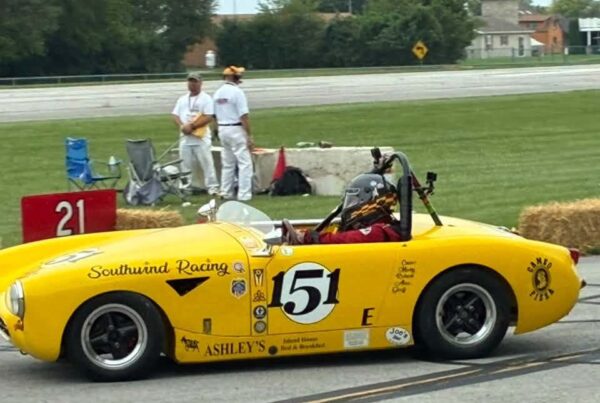
* Right now, I’m building up the rear axle assembly for the ex-SCCA Southern California race car. This is another MG Midget quarter-elliptical sprung wire wheel axle housing, so it won’t require narrowing, and there is some drilling of the brackets for lightening. We’re using another set of the Girling backplates from the Riley 1.5 as base for the 8” x 1-1/2” rear drums.
* We’re going to use the next experiment in Girling rear wheel cylinders on this build. As the 5/8” bore cylinders have become harder to locate I’ve had a few sets of the ¾” cylinders sleeved to 5/8”. I had three sets of the ¾” cylinders one hand, and as they were of no use on the Sebring’s I thought it a reasonable use of otherwise dead stock.
* I’m trying to work out whether the double bearing rear hubs will work with the hand brake levers in the 8” brakes. I’m told the extra width of the double bearing hub with interfere with the hand brake levers on the 7” brakes, but I’m hoping the 8” brakes might provide more clearance.
* We’re also looking at the aftermarket, high strength, axle shafts. I’m not sure the large nut on the outboard end of the three-piece axle shafts will not interfere with the bolt-on splined adapters.
Have you spoken with Andrew Forster lately? I was wondering whether he might have a set of the Sebring doors he used to make, the ones with the fiberglass innards and aluminum skin. I could also use a set of the Speedwell inlets for the next engine build if he had any available.
And, finally, two new mysteries for yourself and your readers!
- I noticed, in the 1961 BMC Competition Catalogue, a close-ratio gear set I had not previously seen. Listed as Q 2354A it consists of; 3rd speed gear 2A3299, 2nd speed gear 22A 37, Laygear (cluster) 22A 39 and 1st Motion Shaft (Drive Gear) 22A 40. No information on actual ratios or tooth counts is given and the part numbers are different than those commonly given for converting the 9C gear box to, closer, Mark II ratios. The 3rd Speed Gear seems to have come from an A30. Any further information on this gear set would be appreciated.
- While looking at FIA Recognition #26, for the Speedwell GT, valid 16 Nov 1960, I noted a gear box ratio with a first gear of 2.569:1, being offered well before the 2.57:1 first gear ratio finally listed on FIA Recognition #568 for the MKIV Sprite, valid 12 Jan 1967. Further, looking at the tooth counts provided on the Recognition Forms it appears the actual gears used are quite different. My original Speedwell catalogs don’t provide any further details. Again, any further information would be appreciated.
Best Regards, Ken Grasing, Oklahoma, USA[A tour of Ken’s cars back in November 2019, on Youtube]