[This page is in the early stages of construction]
Morris Motors Ltd., (Engines Branch) made power units for vehicles produced by the Nuffield Organization, and its factory became part of British Motor Corporation when Morris Motors Limited merged with The Austin Motor Company Limited in 1952. [Wikipedia]
In addition to producing the vast array of production engines for the BMC group, Morris Engines Branch built special engines for competition use, these finding their way into Cooper racing and sports-racing cars, the many racing and rally cars of both the Donald Healey Motor Co and the BMC Competition Department at Abingdon.
In his book “More Healeys”, Geoff Healey says: “The man who probably made the greatest contribution to improving both the power and the strength of the ‘A’ series engine was Eddie Maher at Morris Engines. This was largely as a result of his work on the BMC Formula Junior engine, which continued until 1964 when the Cosworth-developed Ford engines ran away with the series”. He also mentions Maher’s colleague at Morris Engines, Derek Frost, the independent tuner Harry Weslake, Gill Jones and Harry Broom at MIRA, Tim Fry of Rootes and Jim McManus all of whom contributed to the improvements made to the little motor.
Another quote from Geoff: “The 948cc unit fitted to the Frog-eyes and the early MkII.Mk1 Spridgets benefited from Eddie’s work on the Formula Junior engine as used in John Cooper’s car, with which Jackie Stewart did so well. This used the stronger crankshaft, connecting rods and valve gear that were essential if the tuned unit was to stay together. The crankshaft was nitride hardened and manufactured from better alloy steel, and this found its way into most of our racing engines”. This crankshaft was commonly known as the “Red” crank.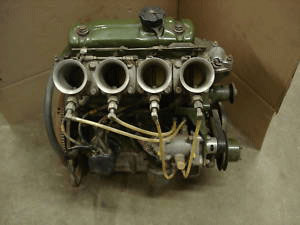
XSP numbers appear to run in the sequence in which they were built, whether they were ‘A’ series, ‘B’ or ‘C’ Series. Here are a few of the ‘A’ series numbers to start us off:
| Engine No. | Fitted to vehicle: | Chassis No | UK Reg No | Capacity |
|---|---|---|---|---|
| XSP 1462/2 | 1958 A35 Competition Car | A2S5/HCS/86838 | PFF 754 | 995cc |
| XSP 581-1 | (2 April 1959) | 5983 AC | 948cc | |
| XSP 1548/1 | 1960 Falcon Sprite Sebring/Le Mans (ST401) | ? | 5983AC | ? |
| XSP 1729-7 | 1959 ‘works’ Sebring Sprite race car | AN5/8145 | UWD 97 | ? 995cc |
| XSP 1736 | Ex-Nick Ramus, Tony Straker,Frank Tiedman | ST 456 | 5435 WD | |
| XSP 1736-1 | 1961 ‘works’ Sprite – Sebring 4 hours | AN5/47400 | 8423 UE | 995cc |
| XSP 1736-2 | 1961 ‘works’ Sprite – Sebring 4 hours/Ecurie Ecosse Le Mans coupe #42 (?XSP1736-4) | AN5/47402 | 8427 UE/1413 WD | |
| XSP 1736-3 | 1961 ‘works’ Sprite – Sebring 4 hours | AN5/47401 | 8424 UE | 995cc |
| XSP 1736-5 | 1961 ‘works’ Sprite – Sebring 4 hours | AN5/47398 | 8425 UE | 995cc |
| XSP 1736-4 | 1961 ‘works’ Sebring Sprite ‘roadster’ (? also fitted to E.Ecosse Le Mans coupe) |
AN5/47399 or ST 450 S | 8426 UE | ? |
| XSP 1862-2 | A ‘works-modified’ Mk 2 Sprite owned by Will Corry believed originally fitted to 1411 WD for the 1962 Sebring 12 Hrs. | HAN6L 21533 | 510 DWD | 1098cc |
| *XSP 1862-4S63 | Believed originally fitted to Healey’s 1963 Le Mans Sprite entry – 58 FAC. (now with Ronnie White. | HAN7-63 H 73-14 | 58 FAC | 1098cc |
| XSP 1862-3 | Alloy-bodied ‘works’ Sebring Sprite Mk 2 | HAN6 ????? | 9251 WD | 995cc* |
| (XSP 1862-2or4?) | Alloy-bodied ‘works’ Sebring Sprite Mk 2 | HAN6 11561 | 9252 WD | 995cc* |
| XSP 1973-7 | ditto for Sebring 1963: | ditto | ditto | 1098cc DS |
| XSP 1862-1 | Alloy-bodied ‘works’ Sebring Sprite Mk 2 | HAN6 11562 | 9253 WD | 995cc |
| XSP 1973-6 | ditto | ditto (for ’63) | ditto | 1098cc DS |
| XSP 1862-5 | Alloy-bodied ‘works’ Sebring Sprite Mk 2 | HAN6 11563 | 9254 WD | 995cc* |
| XSP 1973-8 | ditto | ditto for ’63 | ditto | 995cc DS |
| *XSP 1973-9 | Alloy coupe bodied Sebring/Le Mans Sprite | HAN7-63 H 73-14 | 58 FAC | 1098cc DS |
| XSP/2068-5 | Ex-Alec Poole Frogeye Sprite | AN5/40654 | TZA 238 | 1071cc |
| XSP 2173-4 later XSP 24263? |
Sebring/Le Mans works coupe 1964 | ? | 770 KNX* | 1098cc |
| XSP 2173-2 | 1964 Sebring works coupe | HAN7 11563-H-2 | 776 KNX | 1098cc |
| XSP 2195/3 | Roger Enever ‘works’ MG Midget (July 1965) | GAN3-23948 | 138 DMO | 1293 cc |
| XSP 3139/16 | Owen Tyson’s 1964 Mini (thin flange transverse, no tappet chests) | 1293cc | ||
| XSP 24262 | Alloy bodied works Sprite (1965) | HAN8-R65-5 | DAC 952C | 1293cc |
| XSP 24263 ? | Sebring/Le Mans works coupe in 1965 | ? | DAC 951C* | 1293cc |
| XSP 24264 | 1967 road-going car | PR101 | 4 HAC | 1293cc |
| ? | Alloy bodied works Sprite (1965) | HAN8-R-65-52 | ENX 415C | 1293cc |
| XSP 24266 | Alloy bodied works Sprite (1965) | HAN8-R-65-35 | ENX 416C | 1293cc |
| XSP 3191-3 | A thick wall block with no removable tappet covers, owned by Kim Johnson, Droitwich | 1275cc | ||
| XSP 26044 | Alloy bodied works Sprite (1966) | HAN8-R-143 | HNX 455D | 1293cc |
| XSP 26043 | Alloy bodied works Sprite (1966) | HAN8-R-144^ | HNX456D | 1293cc |
| XSP 26041 | Road-going display alloy bodied Sprite | HAN8-R-202 | – | 1293cc |
| XSP……. | A standard-bodied Sprite Mk4 (Targa Florio) | HAN9-R-157 (TFR 6) | LNX 629E | 1293cc DS |
| XSP 29073 | Alloy-bodied Targa Florio Sprite (1967) | HAN9-R-235 (TFR 5) | LWD 959E | 1293cc FIXF |
| XSP 306326 | Spare engine formerly owned by Jeff Brenner, now by Steve Coleman (2020) | 1293cc FIXF | ||
| XSP 306313 | Alloy bodied Le Mans Sprite (1968) | HAN9-R-237^ | RUE714G | 1293cc FIXF |
| XSP 306314 | (Currently in TFR5 – see 29073 above) | 1293cc FIXF | ||
| XSP306323 | As above (not raced by works) | HAN9-R-238 | – | 1293cc FIXF |
| XSP 306322 | Ex-works alloy bodied roadster | HAN9-R-250 | – | 1293cc FIXF |
* The ’62 engines in the Sprite Mk 2s are known to have used a split centre exhaust port effectively creating a 4-exhaust-port head.
DS: Dry-sump motor.
FIXF: Fuel-injected with crossflow head, and dry sump.
^ same car (144 became 237).
* same car (770 KNX became DAC 951C)
The Cooper Formula Junior Service Parts List shows the following capacities:
| Year | Engine Prefix | Bore | Stroke | Capacity |
|---|---|---|---|---|
| 1960 | XSP/1462 | 2.537″ | 3″ | 995cc |
| 1961 | XSP/1717 | 2.537″ | 3″ | 995cc |
| 1962 | XSP/1722 | 2.667″ | 3″ | 1100cc |
| 1963 | XSP/2036 | 2.82″ | 2.6875″ | 1100cc |
| 1964 | XSP/2224 | 2.82″ | 2.4375″ | 999cc |
Standard BMC engines were:
948 – Bore 2.478″ – Stroke 3″ – Capacity 948cc
1100 – Bore 2.543 – Stroke 3.296″ – Capacity 1098cc
1275 – Bore 2.78″ – Stroke 3.2″ – Capacity 1275cc
(Contributors to this page to date include John Poulter, Rob Maxstone-Graham, James Thacker and David Scothorn to whom I extend my sincere thanks.)
[This page is in the early stages of construction ~ any further information and numbers would be gratefully received.]